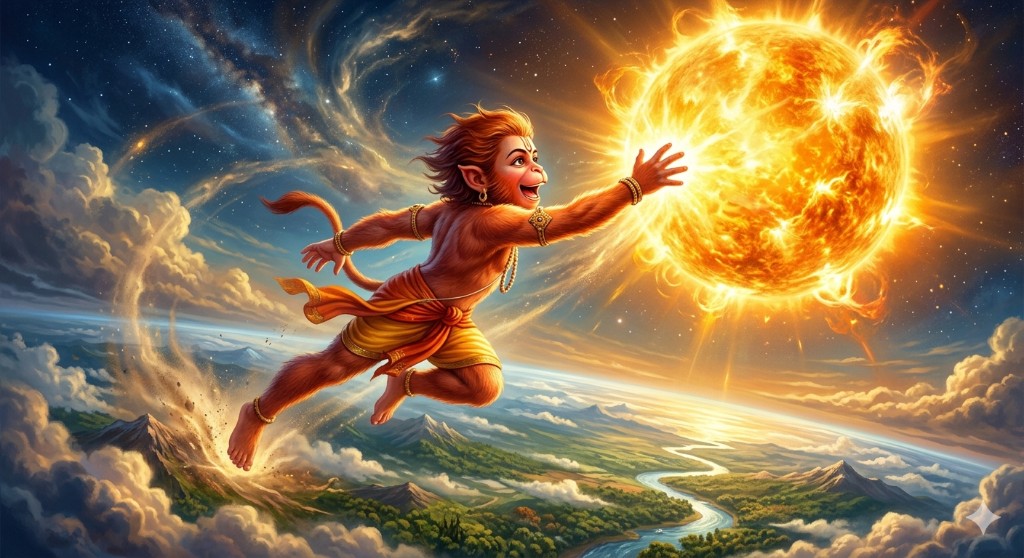
As a child, Hanuman once saw the rising sun and mistook it for a bright, ripe fruit. Eager to eat it, he leapt into the sky and flew toward the sun. The gods were alarmed: the eclipse deity Rahu was at that moment approaching the sun for his monthly ritual, and the child’s speed and power seemed a threat to the cosmic order. Lord Indra struck Hanuman with his thunderbolt (vajra), and the boy fell to the earth, injuring his jaw (hanu). His father, the wind god Vayu, carried him away and withdrew his presence from the world, causing all beings to suffer. To appease Vayu, the gods blessed the child with boons: Indra gave him strength, Surya offered wisdom and mastery of the scriptures, and others granted him various powers. Thus the child who leapt at the sun grew into the mighty, devoted Hanuman of the Ramayana.
Story 2 – Hanuman in Shiva Purana
In the Shiva Purana, specifically within the Shatrudra Samhita, Hanuman is revered as the eleventh incarnation (Avatar) of Lord Shiva. The text narrates a fascinating origin: when Lord Shiva saw the enchanting Mohini form of Lord Vishnu, his divine energy was released. With Shiva's consent, the Saptarishis (seven sages) gathered this potent energy and, through the medium of Vayu (the wind god), established it in the womb of Anjani. Thus, Hanuman was born as a manifestation of Shiva's own power to assist Lord Rama in his mission.
The Purana highlights his childhood feat of swallowing the Sun, his education under the Sun-god, and his pivotal role in the Ramayana—finding Sita, burning Lanka, and bringing the Sanjivani mountain to save Lakshmana. Beyond his physical prowess, the Shiva Purana emphasizes that Hanuman is Bhaktavatsala (affectionate to devotees) and that his worship removes all hurdles, diseases, and worldly problems. He is also credited with establishing the Mahakapishvara Linga, showing his deep devotion to the formless Shiva even while serving Rama.
Story 3 – Panchmukhi Hanuman saves Rama and Lakshmana
During the war in Lanka, when Ravana was being defeated, he turned to his brother Ahiravana, the mighty king of Patal Lok, to change the course of battle. Ahiravana had received a boon from Lord Brahma that he could only be slain if five different lamps placed in five directions were extinguished at the same instant. Confident in this boon, he prepared a secret plan to capture Rama and Lakshmana.
Vibhishana warned Rama about Ahiravana, and Hanuman was posted as the vigilant guardian outside the brothers’ chamber. Ahiravana tried many times to enter but failed. At last, he disguised himself as Vibhishana, slipped past Hanuman, and kidnapped the sleeping Rama and Lakshmana, taking them down to Patal Lok as a sacrifice.
Realising what had happened, Hanuman descended to Patal Lok in search of them. Learning of the boon that protected Ahiravana, Hanuman assumed the formidable Panchmukhi form, manifesting five faces at once to look in all directions. With this five-faced form he blew out the five lamps simultaneously, breaking the boon’s protection, and then slew Ahiravana. In this way, Panchmukhi Hanuman saved Rama and Lakshmana and ensured the victory of dharma.
Hanuman Q&A
Frequently asked questions about Hindu practices and concepts: mantra, yantra, tantra, sadhana, yoga, Kriya Yoga, and the role of the guru.
Shiva Purana & worship
Hanuman using Tail as a seat incident when meeting Raavana
In the original Valmiki Ramayana (the version on this site), no one sits on their own tail during a meeting with Ravana.
Hanuman's meeting with Ravana occurs in Sundara Kanda (after Hanuman destroys the Ashoka grove and is captured). Hanuman stands before Ravana, delivers his message boldly, and there is no mention of him coiling his tail to sit (or making a seat higher than Ravana's throne). Later, Ravana orders Hanuman's tail set on fire as punishment.
There is no episode in Valmiki Ramayana where Angada (or anyone else) visits Ravana's court as an envoy before the war.
The famous scene where a vanara messenger coils/extends their tail to create a high seat (often taller than Ravana's throne, after being denied a seat) is a popular addition found in later retellings, regional/folk versions, and some TV adaptations (like Ramanand Sagar's Ramayan). Sources vary on the character: many folk stories and some narratives attribute it to Hanuman.
Others (including Tulsidas's Ramcharitmanas influences and depictions in temples like Hazara Rama Temple in Hampi) attribute it to Angada (son of Vali), who in some versions is sent as Rama's final peace envoy before the war.
But again, this incident is not present in Valmiki's original text. If you're specifically looking for the authentic Valmiki version (as the site provides), the answer is: no one.
When does Jambavan explain to Hanuman about his powers?
In Kishkindha Kanda, Sarga 66, when Vanaras are searching for Sita:
The vanara army is despondent, unable to find anyone capable of leaping across the ocean to search for Sita.
Jambavan observes this and addresses Hanuman directly, praising his unparalleled strength, valor, and heritage as the son of the wind god (Pavanatmaja).
He motivates Hanuman, reminding him of his innate capabilities and urging him to act.
Inspired by Jambavan's words, Hanuman realizes/recalls his potential, enlarges his form, and prepares for the leap.
Note: The popular story element of Hanuman forgetting his powers due to a childhood curse (from sages after he mistook the sun for fruit, leading to a boon/curse that he would remember them only when reminded) is not explicitly stated in Valmiki's original text. It appears in later retellings, Puranas, folk traditions, and adaptations (e.g., some TV serials expand on this for drama). In Valmiki, it's simply Jambavan inspiring and reminding/encouraging a modest or hesitant Hanuman.
During the war, why is Jambavan mainly searching for Hanuman?
In Yuddha Kanda, Sarga 74:
After Indrajit (Meghnad) unleashes the Brahmastra, Rama, Lakshmana, and vast numbers of vanaras (including most leaders) fall unconscious or fainted.
Hanuman and Vibhishana remain conscious and active. They roam the dark battlefield with torches, searching for Jambavan (the elderly bear king and wise advisor).
They find Jambavan (who is severely wounded but alive). Jambavan, upon hearing them, immediately asks if Hanuman is alive.
Jambavan explains that only Hanuman has the strength and capability to fetch the life-saving herbs from the Himalayas to revive everyone.
Transliteration:
The two heroes, Hanuman and Vibheeshana, and the foremost of Rakshasas with torch in hand searched for the left over Vanaras in the battlefield.
Two of them saw the ground covered with Vanaras of mountain-like forms, who had fallen with tails cut off, some with broken thighs, broken legs and fingers, necks severed, letting off blood, discharging urine and glowing weapons lying on the ground. Vibheeshana and Hanuman saw in the battlefield Sugriva, Angada, Neela, Sarabha, Gandhamadana, Gavaksha, Sushena, Vegadarsi, Ahuka, Mainda, Nala, Jyothimukha, Dwivida and Panasa struck down. By the creator's missile Indrajith struck down sixty-seven crores of strong Vanaras between the fifth and last part of the day.
Vibheeshana and Hanuman seeing the ocean of Vanara army and the glowing arrows on them, looked for Jambavantha.
Paulastya (Vibheeshana of Paulastya clan), seeing the son of Prajapathi (Jambavan), who by nature was wise and aged, afflicted by hundreds of arrows, like a cooling fire sacrifice, went close by and spoke these words. "O Noble Jambavan! Indeed, your life has not been afflicted with these sharp arrows." Hearing this, Jambavan uttered these words with difficulty."
"Great hero, Vibheeshana! I recognise you by your voice. Pierced with sharp arrows I am not able to see you. Vibheeshana (Rakshasa)! Indeed, Hanuman, the foremost of Vanaras, by whose birth, Anjana and Supraja are blessed as parents, are they alive?"
After hearing Jambavantha, Vibheeshana said "Noble son, why are you enquiring about Hanuman?" "Noble one! You are showing affection to Hanuman but not to King Sugriva, or Angada or even Raghava?"
On hearing Vibheeshana, the tiger among Rakshasas, Jambavan replied, "Listen why I enquired about Maruthi." Jambavan states that if Hanuman survives, the army is safe, but if he is dead, they are all as good as dead.
"Dear! If Hanuman who is equal to wind god, resembles Vyshvanara (God of fire) is breathing, then we can hope to live (for life)." Thereafter, Hanuman the son of the wind god coming close to the aged Jambavan clasped his feet in accordance with tradition and greeted him.
Then again, Jambavan whose senses were affected, on hearing the statement of Hanuman, the foremost of Vanaras, felt as though he was born again.
Is Hanuman mentioned as a chiranjeevi in Valmiki Ramayan?
No, in the Valmiki Ramayana text on https://www.valmiki.iitk.ac.in/ (critical edition), Hanuman is not mentioned as a chiranjeevi (immortal or one who lives forever).
This concept appears in later Puranas and devotional traditions, where Hanuman is listed among the seven/eight chiranjeevis (often with a boon from Rama to remain on earth as long as Rama's name is chanted).